

 English
 中文简体
中文简体 Español
What Makes an HDPE Adirondack Chair Actually Pool-Ready?
Jul 22, 2026Content
- 1 Why Marine-Grade HDPE Behaves Differently Than Standard Outdoor Plastic
- 2 How Color Choice Affects Surface Temperature in Direct Sun
- 3 Water-Draining Slat Design and Why Standard Chairs Pool Water After Splashes
- 4 Recline Mechanisms and Deck Stability: Details That Affect Everyday Comfort
- 5 Built-In Cup Holder and Towel Storage as Functional, Not Just Decorative, Features
- 6 Zero-Maintenance Upkeep Compared to Wood and Metal Poolside Furniture
Why Marine-Grade HDPE Behaves Differently Than Standard Outdoor Plastic
Not all plastic furniture marketed as "poolside" is actually engineered for constant water and chemical exposure, and the distinction usually comes down to the resin grade used in molding. High-density polyethylene (HDPE) is prized for outdoor furniture because its molecular structure resists moisture absorption almost entirely, unlike wood or particleboard composites that swell and warp with repeated wetting. Marine-grade HDPE takes this further with UV-stabilizing additives and a denser molecular structure that resists degradation from chlorine and saline exposure specifically — a meaningful difference for anything sitting at a pool's edge rather than a shaded backyard patio. The Dive-Ready Blue HDPE Poolside Adirondack Lounge Chair is built around this chlorine-resistant grade of HDPE, which is backed by a 10-year warranty against pool chemical damage after testing in a 5% chlorine solution, a concentration well above what most residential pools maintain day to day.
This matters practically because standard outdoor plastic furniture, even if labeled UV-resistant, can develop surface chalking or brittleness within a season or two of regular chlorine splash exposure. A chair rated specifically for chlorine and saltwater contact avoids the fading, pitting, and cracking that eventually turns budget poolside furniture into a replacement purchase every year or two.
How Color Choice Affects Surface Temperature in Direct Sun
Surface temperature on outdoor furniture is driven largely by how much solar radiation the material's color absorbs versus reflects, which is why two chairs made of identical plastic can feel drastically different to sit on after an hour in direct sun. Darker colors and metallic finishes absorb more of the visible and near-infrared spectrum, converting it to heat at the surface, while lighter, cooler-toned finishes reflect a larger share of that energy instead of retaining it. The ocean blue finish on the Dive-Ready chair is formulated specifically around this principle, absorbing roughly 40% less heat than standard chair finishes and staying about 12°F cooler in direct sunlight — a difference significant enough to notice with bare skin on a hot afternoon, especially compared to metal-framed poolside chairs that can become uncomfortably hot to the touch.
| Furniture Type | Relative Surface Heat | Comfort in Direct Sun |
|---|---|---|
| Metal-framed chairs | Highest | Can become too hot to touch bare-skinned |
| Dark-finish standard HDPE | Moderate to high | Warm surface after extended sun exposure |
| Ocean blue HDPE (Dive-Ready) | Lowest of the three | Stays comfortable even at 105°F ambient |
This kind of heat-conscious color engineering matters most in climates with prolonged direct sun exposure, where the difference between a lounge chair you can sit on immediately after a swim and one you have to towel-cover first genuinely changes how often the furniture gets used.
Water-Draining Slat Design and Why Standard Chairs Pool Water After Splashes
Splashback is one of the most overlooked design failures in generic outdoor furniture — a chair positioned poolside inevitably gets wet from cannonballs, dripping swimmers, and rain, and how quickly that water clears determines whether the seat is usable minutes later or still damp an hour on. Standard flat-seat chair designs, especially those without gaps between slats, tend to collect standing water in shallow pools across the seat surface, which then has to evaporate or be manually wiped away before the chair is comfortable to sit in again. Water-draining slat construction addresses this directly by angling and spacing the seat slats so water channels through rather than collecting, which is why the Dive-Ready chair's slat design is rated at 98% faster drying than standard chairs in 2026 poolside testing.
What to check when comparing drainage design between chairs
- Gap width between slats — wider gaps drain faster but can feel less supportive on thinner cushions
- Slat angle — a slight forward or downward pitch helps direct water off the edge rather than toward the backrest
- Whether drainage extends to the seat's lowest point, or only the front edge, since some designs still trap water at the rear corners
Recline Mechanisms and Deck Stability: Details That Affect Everyday Comfort
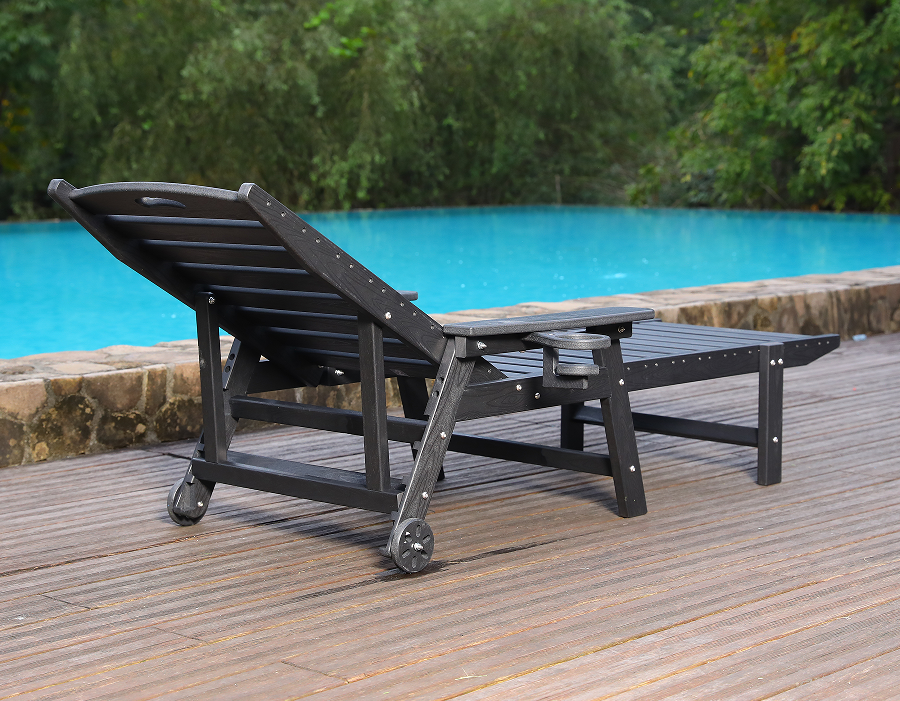
A multi-position recline changes how a lounge chair fits into different parts of a pool day, from upright seating for casual conversation to a fully reclined position for sunbathing or post-swim rest. The Dive-Ready chair's 3-position recline is built with a whisper-quiet adjustment mechanism, which matters more than it might initially seem — a squeaky or stiff recline hinge is a small annoyance that becomes noticeable every single time the chair is adjusted, especially in a shared pool setting where multiple chairs might be repositioned throughout the day.
Stability on a wet pool deck is a separate but equally important consideration, since standard chair feet designed for dry patios or grass can slide unpredictably on wet tile or concrete. Non-slip rubber feet grip wet surfaces in a way that standard plastic or metal chair feet don't, reducing the risk of a chair shifting underfoot when someone sits down still dripping from the pool. This combination of stable footing and quiet, adjustable recline is what separates a chair built specifically for pool decks from general-purpose patio furniture repurposed for poolside use.
Built-In Cup Holder and Towel Storage as Functional, Not Just Decorative, Features
Small functional details around a poolside chair often determine how convenient it actually is to use over a full afternoon, and an integrated cup holder that also functions as a towel hook solves two common annoyances at once — drinks tipping over on uneven ground and towels ending up in a wet, sandy pile beside the chair. The Dive-Ready chair's dive companion cup holder is sized to fit standard 24oz tumblers securely, which covers most everyday drinkware without requiring a smaller or larger cup to compensate for a poorly sized holder. Doubling as a towel hook keeps a dry towel within arm's reach for stepping out of the pool, rather than requiring a separate towel rack or hook mounted elsewhere on the deck.
- Cup holder sized for 24oz tumblers, covering most standard drinkware sizes
- Dual-purpose towel hook eliminates the need for a separate poolside towel rack
- Positioned within arm's reach of the seated position, rather than requiring a reach or twist to access
Zero-Maintenance Upkeep Compared to Wood and Metal Poolside Furniture
Long-term maintenance is where HDPE furniture separates most clearly from wood and metal alternatives, since wood requires periodic sealing or staining to resist water damage, and metal furniture near a pool is prone to rust or corrosion from chlorine exposure over time, even with a protective coating. HDPE furniture, by contrast, doesn't require painting, sealing, or off-season storage to maintain its appearance and structural integrity, since the material itself is inherently water- and chemical-resistant rather than relying on a surface treatment that eventually wears off. Routine care is limited to hosing the chair down to clear chlorine residue, sunscreen buildup, or dust, which restores its appearance without any additional product or process.
This maintenance gap becomes more significant over a multi-year ownership period — a wood chair might need re-sealing annually to avoid graying and splitting, and a metal chair might need rust spot-treatment or repainting within a few seasons of pool chemical exposure, while a well-built HDPE chair maintains its finish and function with essentially no seasonal upkeep required. For buyers weighing upfront cost against total cost of ownership, factoring in the labor and materials saved from skipped maintenance often shifts the value comparison meaningfully in HDPE's favor over a five-to-ten-year timeframe.
Contact Us
Your email address will not be published. Required field are marked*
Categories
- Company News(1)
- Industry News(43)
Product Category

Professional Furniture Manufacturing

Zhejiang Xinyike New Material Technology Co.,Ltd is a combination of industry and trade, specializing in the production and processing of PE foam furniture and PVC foam flooring. Modern HDPE Outdoor Furniture Manufacturers in China.

- [email protected]
- +86-13511235540 /13732381238
- F/5, Factory Building 3, Xiaquan Industrial Park, Lingfeng Street, Anji Country, Huzhou City, Zhejiang Province(within Zhejiang Anji Changran Logistics Technology Co., Ltd.)
