

 English
 中文简体
中文简体 Español
Why Does High-Density Polyethylene Outlast Wood and Metal in Sun, Rain, and Coastal Conditions?
May 21, 2026Content
- 1 What High-Density Polyethylene Actually Is
- 2 How HDPE Resists UV-Induced Fading and Color Degradation
- 3 Why HDPE Does Not Crack or Warp Under Temperature Extremes
- 4 HDPE Performance in Coastal and High-Moisture Environments
- 5 HDPE vs. Wood, Metal, and PVC: A Side-by-Side Comparison
- 6 Common Outdoor Products Crafted from High-Density Polyethylene
- 7 How to Care for and Maximize the Life of HDPE Outdoor Products
When choosing materials for outdoor furniture, fencing, decking, or marine fixtures, durability is not just a preference — it is a necessity. Products exposed to direct sunlight, heavy rainfall, salt air, and seasonal temperature swings demand a material engineered to endure every condition without compromising appearance or structural integrity. High-density polyethylene (HDPE) has become the benchmark for outdoor performance precisely because it is crafted to resist fading, cracking, and warping in sun, rain, or coastal conditions. Understanding how and why HDPE achieves this level of resilience helps buyers, contractors, and property owners make smarter, longer-lasting investments.
What High-Density Polyethylene Actually Is
High-density polyethylene is a thermoplastic polymer produced from ethylene monomers through a catalytic polymerization process that creates tightly packed, linear molecular chains. This molecular architecture gives HDPE a density ranging from 0.93 to 0.97 g/cm³, a tensile strength of 20–37 MPa, and a notably high strength-to-density ratio. Unlike low-density polyethylene (LDPE), which has branched chains and a more flexible structure, HDPE's linear configuration produces a harder, stiffer, and far more weather-resistant material.
For outdoor applications, manufacturers use virgin or recycled HDPE stock combined with UV stabilizers, colorfast pigments, and antioxidant additives that are compounded directly into the material — not applied as a surface coating. This distinction is critical: surface treatments can chip, peel, or wear away over time, whereas additives built into HDPE's molecular structure remain active throughout the product's entire service life. The result is an outdoor material that maintains its color, shape, and structural strength for decades rather than years.
How HDPE Resists UV-Induced Fading and Color Degradation
Ultraviolet radiation is one of the primary causes of outdoor material degradation. UV-B rays (wavelengths of 280–315 nm) break chemical bonds in polymer chains — a process called photodegradation — causing chalking, surface crazing, and significant color loss. Woods turn gray and splinter. Aluminum fades and develops oxidation streaks. Standard plastics yellow and become brittle. HDPE avoids this deterioration through two complementary mechanisms built directly into its formulation.
The first is the incorporation of UV absorbers, typically benzophenones or hydroxyphenyltriazines, which absorb UV energy and convert it to harmless heat before it can attack the polymer backbone. The second is the use of hindered amine light stabilizers (HALS), which interrupt the free-radical chain reactions that UV exposure initiates. Together, these additives extend color retention and surface stability dramatically. Independent accelerated weathering tests following ASTM G154 (UV exposure cycling) regularly show that quality outdoor HDPE retains over 90% of its original color intensity after the equivalent of 10+ years of sun exposure.
Colorfast pigments — typically inorganic iron oxides, titanium dioxide-based whites, or carbon black — are selected specifically for their photostability. Because these pigments are dispersed uniformly throughout the HDPE mass rather than applied as paint, any surface scuff or scratch simply reveals the same color below, ensuring the product never looks worn or patchy even after years of heavy use outdoors.
Why HDPE Does Not Crack or Warp Under Temperature Extremes
Cracking and warping occur when a material cannot accommodate the dimensional changes that temperature swings impose. Wood absorbs and releases moisture as humidity and temperature fluctuate, causing it to expand and contract unevenly — the mechanism behind warped deck boards, cracked fence rails, and swollen gate frames. Metals expand and contract at their own coefficient of thermal expansion, and differential heating across a single component can buckle or stress joints over time.
HDPE's thermal expansion coefficient of approximately 120–200 µm/m·°C is predictable and uniform across the material's cross-section. More importantly, HDPE does not absorb water. Its moisture absorption rate is less than 0.01% after 24 hours of immersion per ASTM D570, which means it does not swell in humidity or contract when it dries. This hygroscopic stability is the primary reason HDPE boards and planks remain flat and true even after years of exposure to wet-dry cycles that would destroy wood composites.
Impact Resistance in Cold Climates
In freezing temperatures, many plastics become brittle and crack under mechanical stress. HDPE is a notable exception. Its impact resistance remains high down to –40°C, making it suitable for year-round outdoor installation in northern climates where competing materials like PVC or wood composites suffer freeze-thaw cracking. Outdoor HDPE furniture, dock boards, and fencing installed in Minnesota, Canada, or Scandinavia consistently survive harsh winters without the surface checking or joint failure common to wood alternatives.
Structural Stiffness and Load Retention
Flexural modulus — a measure of stiffness — for HDPE typically ranges from 800 to 1,500 MPa. While this is lower than aluminum or hardwood, engineered HDPE outdoor products compensate through profile design: hollow channels, ribbed undersides, and reinforced cross-sections that distribute load efficiently. Properly engineered HDPE decking and furniture maintain their form under static loads without the creep failure seen in cheaper polyethylene grades or recycled mixed-plastic lumber.
HDPE Performance in Coastal and High-Moisture Environments
Coastal environments present a uniquely aggressive combination of stressors: salt-laden air accelerates corrosion of metals, moisture promotes mold and rot in organic materials, and the frequent wet-dry cycle of marine splash zones creates conditions that destroy most conventional outdoor materials within a few years. HDPE is inherently inert to salt, chlorine, and most dilute acids and bases, making it chemically resistant to everything coastal exposure can deliver.
Salt does not corrode HDPE as it does steel, aluminum, or galvanized hardware. Salt air does not penetrate the surface or initiate delamination as it does with painted wood or fiber-reinforced composites. Marine organisms — including barnacles, algae, and mussels — can attach to any submerged surface, but HDPE's smooth, non-porous surface is far easier to clean than rough or textured wood, and it does not provide the organic substrate that accelerates biological fouling.
For dock systems, waterfront benches, boat accessories, and coastal boardwalks, HDPE has become the material of choice in many port authorities and marina operators. Products rated for marine-grade outdoor use typically carry NSF/ANSI 51 certifications for food contact (relevant for fish cleaning stations and marina facilities) and ASTM D4329 UV weathering compliance, confirming suitability for continuous coastal exposure.
HDPE vs. Wood, Metal, and PVC: A Side-by-Side Comparison
Selecting the right outdoor material requires an honest assessment of how competing options perform across the conditions that matter most. The table below compares HDPE directly against pressure-treated wood, powder-coated aluminum, and cellular PVC across the five most critical outdoor performance categories.
| Performance Factor | HDPE | Pressure-Treated Wood | Powder-Coated Aluminum | Cellular PVC |
|---|---|---|---|---|
| UV Color Fastness | Excellent (10+ yrs) | Poor (grays within 1–2 yrs) | Good (coating fades 5–8 yrs) | Moderate (yellows 3–5 yrs) |
| Moisture Resistance | Excellent (<0.01% absorption) | Poor (rots, warps, swells) | Good (seams can corrode) | Good (surface, not structural) |
| Salt/Coastal Resistance | Excellent | Poor | Moderate (pitting risk) | Good |
| Cold-Weather Impact Resistance | Excellent (to –40°C) | Moderate (checks, cracks) | Good | Poor (brittle below –10°C) |
| Annual Maintenance Required | None | High (staining, sealing) | Low to Moderate | Low |
Common Outdoor Products Crafted from High-Density Polyethylene
HDPE's combination of weather resistance, structural integrity, and low maintenance has driven its adoption across a wide range of outdoor and marine product categories. The breadth of applications reflects how versatile the material is when properly engineered for outdoor performance.
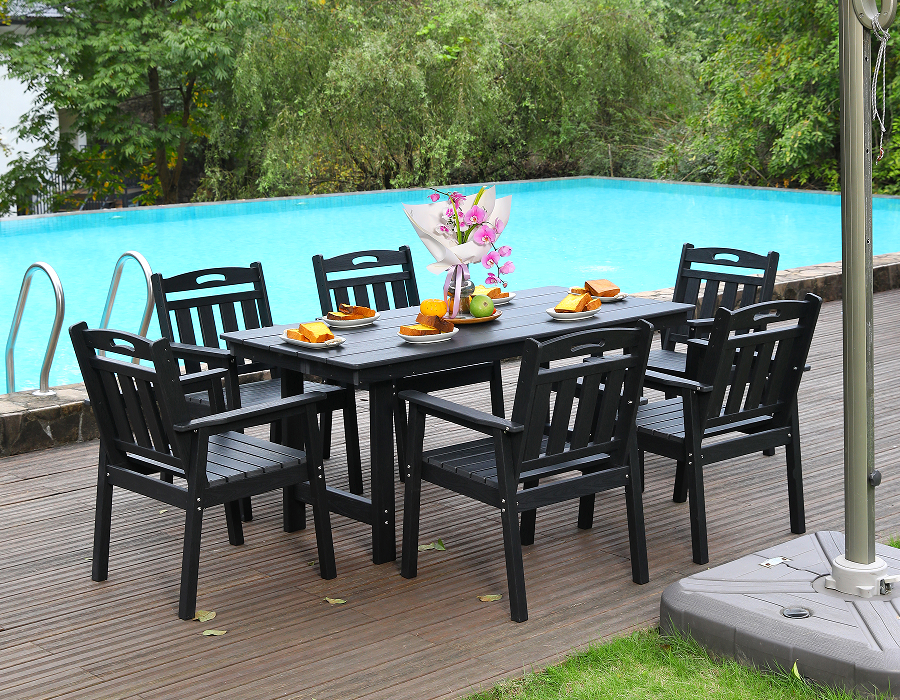
- Outdoor furniture: Adirondack chairs, benches, dining sets, and chaise lounges — products that face seasons of direct sun and rain without requiring any refinishing or protective covering
- Decking and dock boards: Marine-grade HDPE planking used for boat docks, waterfront decks, and pool surrounds where constant wet exposure would rot or corrode alternative materials
- Fencing and privacy screens: Ranch-style, picket, and privacy fence panels that install once and remain straight, solid, and color-stable for 20+ years
- Playground equipment: Structural lumber, handrails, and panels for commercial playgrounds where splinter-free, non-toxic performance is mandatory alongside weather resistance
- Marine accessories: Dock cleats, fender boards, navigation signs, and fish cleaning tables in saltwater environments
- Agricultural and industrial uses: Livestock gates, feed bins, troughs, and equipment housings that face chemical exposure, UV, and physical abuse simultaneously
How to Care for and Maximize the Life of HDPE Outdoor Products
One of HDPE's most appreciated practical advantages is that it requires almost no routine maintenance. Unlike wood, it does not need annual staining, sealing, or sanding. Unlike painted metal, it does not require touch-up paint to prevent rust spread. In most residential and commercial settings, keeping HDPE products clean involves nothing more than occasional washing with mild soap and water or a diluted household cleaner.
For surface marks or minor staining — common in high-traffic public installations — a soft-bristle brush with a solution of warm water and dish soap removes most contaminants without damaging the surface. For more stubborn stains such as bird droppings, tannin from leaves, or mold growth in shaded areas, a diluted bleach solution (1 part bleach to 10 parts water) applied briefly and rinsed thoroughly is effective and will not harm the HDPE polymer or its colorants.
Pressure washing is also safe for HDPE, provided the nozzle is kept at a reasonable distance (at least 12 inches / 30 cm) to avoid concentrating force on any single point. Avoid using abrasive steel wool or harsh solvents such as acetone, as these can scratch the surface gloss or compromise the UV stabilizer layer. With these simple precautions in place, an HDPE outdoor product purchased today can reasonably be expected to look and perform just as well 25 years from now — a longevity that no wood or paint-finished metal product can realistically match under the same outdoor conditions.
Contact Us
Your email address will not be published. Required field are marked*
Categories
- Company News(1)
- Industry News(47)
Product Category

Professional Furniture Manufacturing

Zhejiang Xinyike New Material Technology Co.,Ltd is a combination of industry and trade, specializing in the production and processing of PE foam furniture and PVC foam flooring. Modern HDPE Outdoor Furniture Manufacturers in China.

- [email protected]
- +86-13511235540 /13732381238
- F/5, Factory Building 3, Xiaquan Industrial Park, Lingfeng Street, Anji Country, Huzhou City, Zhejiang Province(within Zhejiang Anji Changran Logistics Technology Co., Ltd.)
