

 English
 中文简体
中文简体 Español
Patio Furniture Made from Recycled Plastic: What Every Buyer Should Know
Oct 14, 2026Content
- 1 What Counts as Recycled Plastic Patio Furniture
- 2 Why HDPE Holds Up Better Than Wood, Metal and Cheaper Resins
- 3 How Recycled Plastic Furniture Is Actually Made
- 4 Comparing Outdoor Furniture Materials
- 5 Matching Pieces to the Way You Use Your Patio
- 6 What to Check Before You Buy
- 7 Keeping Recycled Plastic Looking New
- 8 Sourcing Recycled Plastic Furniture at Scale
Walk past a well-made recycled plastic chair and you might mistake it for painted timber. Sit in it and the difference becomes obvious: no splinters, no wobble, no varnish smell, and no scramble to bring it indoors when the sky turns grey. That quiet reliability is why patio furniture made from recycled plastic has grown from a niche idea into a mainstream choice across North America, Europe and Australia.
We build this furniture for a living. Zhejiang Xinyike New Material Technology is an HDPE foam furniture manufacturer with our own CNC workshop, and our pieces now sit on patios, pool decks and balconies in more than 35 countries, including supply programmes for a number of Fortune 500 retailers. What follows is what we would tell a friend who asked us what actually matters.
What Counts as Recycled Plastic Patio Furniture
"Recycled plastic" is a broad label, and not every product carrying it is built the same way. Outdoors you will usually meet one of four materials:
- Post-consumer HDPE. Milk jugs, shampoo bottles, detergent containers and bottle caps, sorted, washed, shredded and melted back into pellets.
- Post-industrial regrind. Offcuts, test pieces and rejected parts from a factory's own line, ground down and fed back into production. Genuinely recycled, though it never left the building.
- Wood-plastic composite. HDPE mixed with sawdust, often close to a fifty-fifty split. Warmer looking, but it absorbs more moisture and can support mould in damp shade.
- Mixed or polypropylene resin. Cheaper, softer and usually less UV-stable. Fine for a lightweight side table, less suited to a chair that lives outside all year.
Recycled content also comes in different strengths. Many manufacturers blend recycled HDPE with virgin resin, commonly somewhere between 20 and 80 percent recycled, because recycled streams vary in colour and melt behaviour from batch to batch. Stabilisers and pigments are added to bring the mix back to a consistent, colourfast board. None of that is a trick, but it does mean the recycled percentage is worth asking about, and worth getting in writing. Ask too whether the figure covers the whole piece or only the plastic parts, since fasteners and hardware are usually a different material altogether.
Why HDPE Holds Up Better Than Wood, Metal and Cheaper Resins
The case for high-density polyethylene outdoors comes down to one property: it does not absorb water. Wood swells, splits and rots; steel rusts from the inside out; aluminium corrodes around coastal salt; powder coatings chip and then let moisture underneath. Solid HDPE simply sheds rain, and because it takes on no moisture it also survives freeze-thaw cycles in cold climates without cracking.
Three more things follow from the same starting point. Insects and fungi find nothing to eat, so no chemical treatment is needed. The pigment is mixed through the board rather than painted on top, so a scratch is far less visible than it would be on a coated surface. And there is no annual oiling, sanding or repainting, which is often the hidden cost of a cheaper wooden set.
Two caveats are worth knowing. HDPE is only as good as its UV package: without proper stabilisers, any plastic will chalk and fade in strong sun. And dark colours get noticeably warm under direct afternoon sun, which matters if the furniture is used bare-legged by a pool. We go deeper into the material science in our note on why HDPE outlasts wood and metal in the sun.
How Recycled Plastic Furniture Is Actually Made
Understanding the process is the easiest way to judge quality, because almost every shortcut shows up as a fault within two or three seasons.
- Sorting and washing. Incoming plastic is separated by resin type and colour, then washed to remove labels, caps and residue. Dirty feedstock is the main cause of weak, blotchy board.
- Grinding and compounding. Clean flakes are ground fine and blended with UV stabilisers and pigment to a consistent colour.
- Extrusion. The compound is melted and pressed into a dense board or foam profile of controlled thickness.
- CNC cutting and drilling. Boards are routed into shaped parts. We do this in our own CNC workshop, which lets us hold tight tolerances on curves, slats and joinery instead of relying on one fixed mould.
- Assembly. Parts are fastened together, usually with 304 stainless steel hardware, so the fixings last as long as the plastic around them.
- Finishing. Edges are polished and chamfered by hand. Buyers notice this step without realising it, because it is what separates a crisp profile from a rough, unfinished edge.
Because parts are routed from board rather than moulded as a single shell, a slat or leg can be replaced individually years later. That is a real advantage over one-piece resin furniture, which tends to be discarded the moment one section fails.
Comparing Outdoor Furniture Materials
The table below is a practical summary of how the main outdoor materials compare for a typical residential patio.
| Material | Recycled content | Weather resistance | Typical upkeep | Weight |
|---|---|---|---|---|
| Recycled HDPE | Low to high | Excellent | Occasional wash | Heavy |
| Teak and hardwood | None | Good if oiled | Oil or seal yearly | Heavy |
| Powder-coated aluminium | Low to medium | Very good | Touch up chips | Light |
| Painted steel | Low | Poor unless treated | Rust treatment | Heavy |
| Natural rattan and wicker | None | Poor | Cover or store | Light |
Matching Pieces to the Way You Use Your Patio
Recycled plastic works across the whole outdoor range, but the right shape depends on how the space is actually used rather than on a catalogue photograph.
Seating for long afternoons
Adirondack chairs stay the classic choice for a reason: the deep seat, wide arms and reclined back are built for an hour of reading rather than ten minutes of sitting. Our own Adirondack chair range covers upright, cross-back and reclining silhouettes, and the comfort gap between them is wider than the price gap. If you prefer gentle movement, a rocking chair earns its place on a porch or under a pergola.
 Navy Blue HDPE Adirondack Chair with Stainless Steel HardwareClassic Adirondack comfort in weather-resistant HDPE, with sloped back, wide armrests, and 304 stainless steel hardware for patios.View Product →
 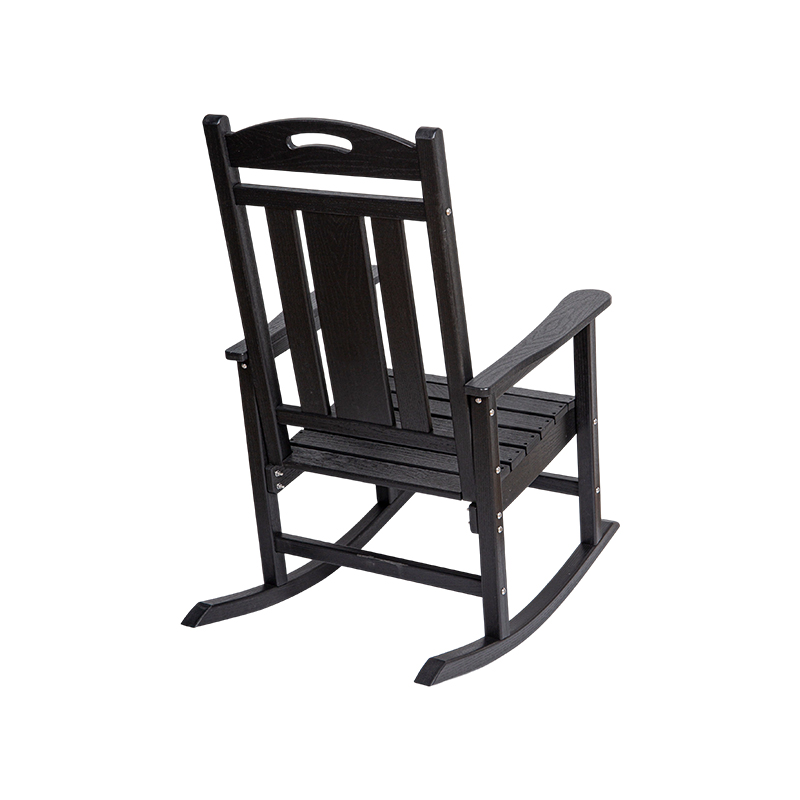 Wholesale HDPE Recycled Black Patio Rocking ChairWeather-resistant HDPE rocking chair with smooth motion, wide armrests, and 304 stainless steel screws, suited to porches, patios, and commercial outdoor spaces.View Product →
Dining and gathering
For meals, look at slab-style tables with slatted or solid tops and chairs that tuck in without scraping. Bar-height sets suit narrow balconies where a full-size table would crowd the space. In every case, check the tabletop thickness: a heavier top resists wind lift and stays flat through years of sun.
Sofas, gliders and side tables
Loveseats and three-seat sofas bring indoor comfort outdoors, and matching coffee or side tables tie the arrangement together. This is where the colour-through finish proves its value, because a coffee table takes more knocks than anything else on a patio.
 Gray HDPE All-Weather Outdoor Loveseat Double SofaTwo-seater HDPE loveseat with corrosion and UV resistance, 304 stainless steel screws, and easy assembly, bringing indoor-style comfort to patios.View Product →
What to Check Before You Buy
- Board thickness. Thicker boards feel stiffer and hold their shape, especially in long benches and table tops.
- UV performance. Look for a written fade warranty rather than a general promise of UV resistance.
- Hardware material. Grade 304 stainless steel will outlast painted or zinc-plated steel by years in coastal air.
- Colour consistency. With recycled content, ask how the maker controls shade variation between batches.
- Recycled content in writing. A specific figure, not a marketing phrase.
- Assembly and spares. Count the parts, check the tools needed, and confirm that individual slats and legs can be reordered.
Keeping Recycled Plastic Looking New
Maintenance is deliberately dull, which is the whole point.
- Rinse with a hose and wipe with mild soapy water two or three times a season.
- Skip solvents, bleach and abrasive pads, which dull the surface and can pull pigment out of the board.
- Do not oil, stain or seal the material. It has nothing to feed and nothing to protect.
- Tighten fasteners once a year, particularly after the first season as the furniture settles.
- Store cushions indoors; the frames themselves are happy to stay out in rain and snow.
Sourcing Recycled Plastic Furniture at Scale
For retailers, brands and distributors, the questions shift from comfort to supply. Recycled feedstock availability fluctuates, so a supplier needs either several streams or a controlled blend to keep colour and density stable across a season. Capacity matters just as much: our own line handles more than ten thousand pieces a year, with tooling that supports everything from a single side table to a full dining set.
It is also worth asking who does the cutting. A factory with in-house CNC equipment can adjust a profile, thickness or hole pattern without waiting on a new mould, which shortens sampling and makes custom colours and hardware far more practical.
Recycled plastic is no longer a compromise material. It is heavy where weight helps, quiet underfoot, unbothered by rain, and finished well enough to sit beside timber without apology. Whether you are furnishing one balcony or planning a full seasonal programme, take the time to compare board thickness, colourfastness and hardware before you commit, and ask for samples so you can judge the material with your own hands rather than through a photograph.
Contact Us
Your email address will not be published. Required field are marked*
Categories
- Company News(1)
- Industry News(47)
Product Category

Professional Furniture Manufacturing

Zhejiang Xinyike New Material Technology Co.,Ltd is a combination of industry and trade, specializing in the production and processing of PE foam furniture and PVC foam flooring. Modern HDPE Outdoor Furniture Manufacturers in China.

- [email protected]
- +86-13511235540 /13732381238
- F/5, Factory Building 3, Xiaquan Industrial Park, Lingfeng Street, Anji Country, Huzhou City, Zhejiang Province(within Zhejiang Anji Changran Logistics Technology Co., Ltd.)
