

 English
 中文简体
中文简体 Español
Durable Outdoor Lounge Chairs: How HDPE Stands Up to Sun, Rain, and Humidity
Sep 02, 2026Content
After two summers, most “durable” outdoor lounge chairs show cracks, fading, or rusted fasteners. The frame starts to feel loose, and the surface becomes gritty. From a commercial buyer’s perspective, those small failures turn into returns, warranty claims, and future order losses. The fastest way to avoid that risk is to choose a lounge chair built from high-density polyethylene (HDPE) with stainless steel hardware. HDPE withstands UV radiation, rain, salt air, and temperature swings without peeling or corroding. This guide breaks down what durability actually requires, how HDPE performs against common alternatives, and what specific features matter when sourcing lounge chairs for long-term use.
What Does “Durable” Mean in Outdoor Lounge Chairs?
“Durable” is not a static peak load rating. It is the product’s ability to keep its structure and looks after thousands of hours of sun exposure, repeated rain cycles, and daily physical stress. Four factors control that outcome: the polymer type, the hardware grade, the frame design, and the color penetration.
| Criteria | HDPE | Metal (coated steel/aluminum) | Wood (teak/cedar) |
|---|---|---|---|
| UV performance | High if UV stabilizers are added; color goes through the material | Coating can chalk or peel; aluminum is resistant but often painted | Natural wood turns gray unless oiled; teak can crack over time |
| Rust behavior | No rust; unaffected by moisture or chlorine | Steel will rust at scratches and fasteners; aluminum does not rust but can oxidize | No rust, but molds and stains are common |
| Maintenance | Wipe with mild soap; no oiling or repainting | Touch-up paint and rust removal needed | Annual oiling or sealing, sanding of rough spots |
| Typical lifespan | 10+ years with visible wear limited to surface residue | 5–8 years if coating remains intact | 5–10 years depending on care |
The table shows that HDPE’s main advantage is not strength alone, but the absence of failure modes inherent to coated metals and treated wood. A porous paint layer or a single scratch is all it takes for corrosion to start on steel frames. Wood requires a protective oil film that needs reapplication. HDPE simply has no surface coating to protect. For a detailed breakdown of the polymer-level differences, see our article on key material advantages of HDPE chairs in outdoor furniture.
How HDPE Stands Up to Sun, Rain, and Salt Air
HDPE is a thermoplastic polymer. Unlike polypropylene, which can become brittle in cold weather, or acrylic, which can soften in direct summer heat, HDPE holds a broad operating range from -40°C to 80°C. When UV inhibitor packages are mixed into the resin before molding, the color becomes part of the material itself. A chip or scratch does not reveal a different color underneath, which is critical for lounge chairs used in hotels, rental properties, or public pools.
One example is a poolside lounge chair: pool chemicals and salt water are harsh on almost every metal fitting. But HDPE loungers with 304 stainless steel hardware eliminate rust rings on deck tiles and keep the chair structurally sound for continuous outdoor placement. For buyers sourcing from a factory, ask whether the hardware is 304 stainless or lower-grade 201 stainless, and whether the resin has a verified UV8 rating.
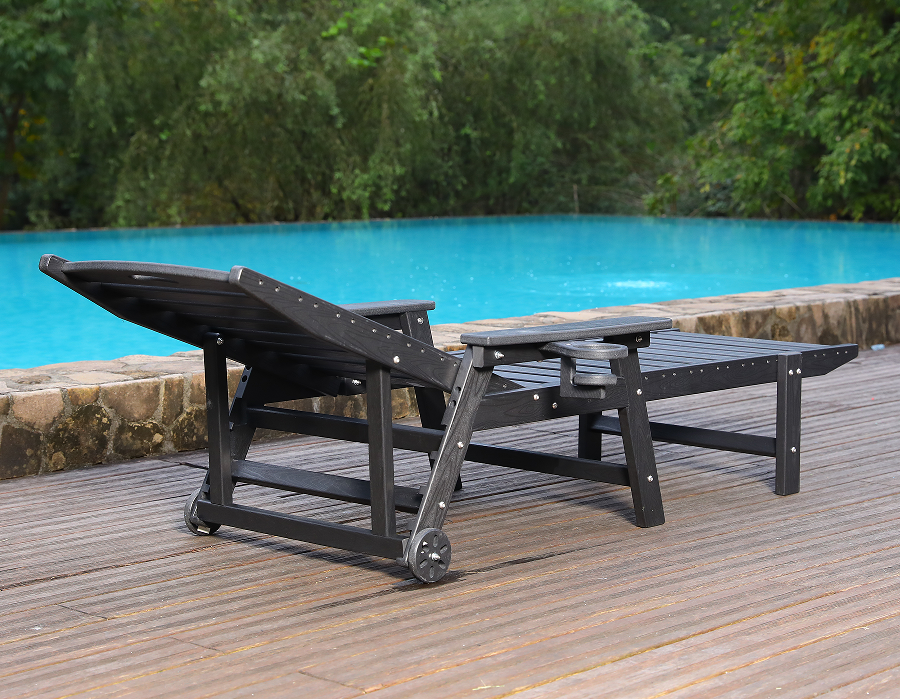 Dive-Ready Blue HDPE Poolside Adirondack Lounge Chair for Chlorine and Saltwater EnvironmentsThis poolside lounge chair uses marine-grade HDPE and 304 stainless steel hardware to resist chlorine and saltwater corrosion, with a UV-stable blue finish and water-draining slats for wet-deck use.View Product →
What to Inspect Before You Buy in Bulk
If you are a purchasing manager replacing furniture for a resort or a retail buyer preparing a 1000-piece order, the visual finish is only a small part of the equation. Here are five concrete checks for any durable outdoor lounge chair:
- Seat and backrest thickness: a lounge chair for commercial use should have a wall thickness of at least 6 mm at the stress points. This prevents flexing under repeated load from adults.
- Fastener design: pre-inserted stainless steel inserts and through-bolts prevent stripping and allow the chair to be disassembled and transported without losing its resistance.
- Reclining mechanism: if the chair has adjustable backrests, check that the locking positions use a tool-free, heavy-duty ratchet system rather than a plastic clip that cracks at 40°C.
- Color fastness: request a color sample and verify that the declared UV resistance is not only on the surface. For HDPE, the color is molded through the whole panel.
- Load capacity: test or request exact specifications. A durable lounge chair should support 120 kg to 150 kg without visible deformation, not just for a static load, but also for the rocking motion that occurs when someone shifts weight.
Buying decisions often fall apart when the lounge chair looks good in a showroom but fails after one high-humidity summer. That is why many importers now request scratch, moisture, and salt spray tests before committing a full container. If you are still evaluating different lounge chair formats, this article on how to choose the best outdoor patio chaise lounge covers the main layout differences.
How Your Supplier’s Manufacturing Depth Affects Durability
The same material can produce very different results depending on the production process. A factory with its own CNC machining center can cut precise profiles and drill clean holes for the hardware, which reduces stress concentrations. A supplier that only finishes or assembles parts may accept tolerances that create excessive play in the frame.
Zhejiang Xinyike New Material Technology Co., Ltd. is a manufacturer with over six years of PE foam experience. The company exports to more than 35 countries and serves as a primary supplier to several Fortune 500 companies. Those experiences feed directly into product development: the chairs are CNC-machined for accurate joints, and the hardware is selected for corrosive environments. For example, the storm-gray HDPE frog-style lounge chair is a good fit for customers who want an outdoor chair with a slightly lower silhouette but the same all-weather performance. It uses the same welded-look profile and molded color through, keeping maintenance almost zero.
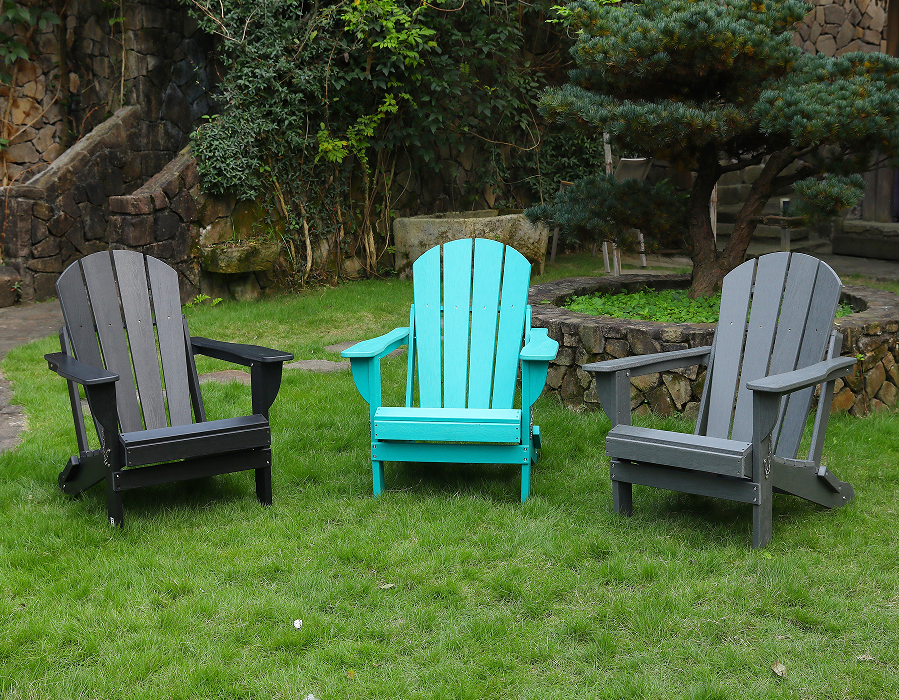 Storm Gray HDPE Adirondack Frog Chair with Ergonomic Recline and All-Weather DurabilityThis all-weather HDPE chair features a lower frog-style silhouette, molded color-through construction, and reliable hardware, making it a low-maintenance option for patios and coastal areas.View Product →
How to Choose a Durable HDPE Lounge Chair for Your Patio or Poolside
As a final step, match the chair to the micro-environment. For coastal or public pools, prioritize the poolside model with a UV-stable blue finish and 304 stainless steel hardware. For residential patios where the chair sits under a pergola, a simple HDPE Adirondack lounge chair delivers excellent comfort and support. A single HDPE lounge chair with a classic silhouette is often the most cost-effective option for smaller gardens, balconies, and hotel guest rooms.
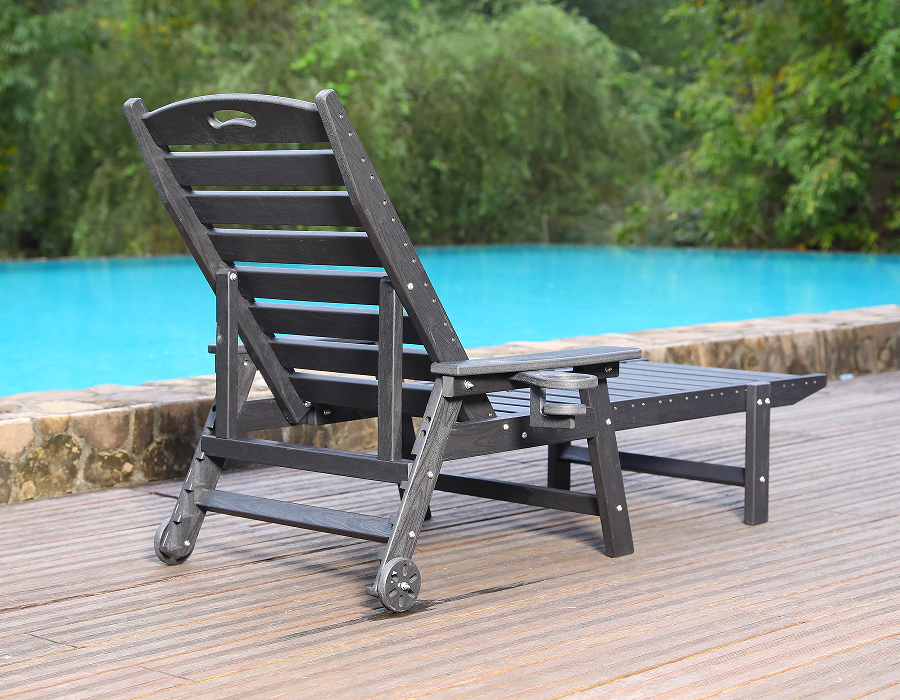 Urban Gray HDPE Single Adirondack Lounge Chair for Compact Balconies and Modern PatiosDesigned for small urban spaces, this single HDPE lounge chair offers a classic silhouette, three-position recline, and a compact footprint, providing cost-effective comfort for gardens and guest rooms.View Product →
As a buyer, you should also ask the manufacturer to verify the material grade, the fastener grade, and the expected lifespan under local UV conditions. If a supplier offers a lower-priced wood or coated steel lounge chair, calculate the total cost of ownership: oil, paint, spare parts, and replacements over 10 years. HDPE usually wins that calculation even when the initial unit price is a little higher.
There is no need to let every springtime turn into a repair season. With HDPE construction, you get a lounge chair that does not depend on a sacrificial coating or a maintenance ritual. Whether you are outfitting a hotel pool deck, a rooftop terrace, or a residential garden, the concrete spec to remember is: molded-through HDPE, 304 stainless steel hardware, and verified UV stabilization. That combination keeps your purchase comfortable and visually consistent for years.
Contact Us
Your email address will not be published. Required field are marked*
Categories
- Company News(1)
- Industry News(43)
Product Category

Professional Furniture Manufacturing

Zhejiang Xinyike New Material Technology Co.,Ltd is a combination of industry and trade, specializing in the production and processing of PE foam furniture and PVC foam flooring. Modern HDPE Outdoor Furniture Manufacturers in China.

- [email protected]
- +86-13511235540 /13732381238
- F/5, Factory Building 3, Xiaquan Industrial Park, Lingfeng Street, Anji Country, Huzhou City, Zhejiang Province(within Zhejiang Anji Changran Logistics Technology Co., Ltd.)
